
The filter the bearings depend on.
The oil in a screw compressor carries the heat, seals the rotors and feeds the bearings. The oil filter takes the wear metal, the oxidation residue and the dust out of it on every pass, so the same oil can do that job for thousands of hours.
Four steps around the oil circuit.
There is no oil pump in most screw compressors. The pressure in the separator tank pushes the oil round, and the filter is the last stop before it goes back into the element.
Out of the tank
Oil collects at the bottom of the separator tank at system pressure. The pressure difference to the injection point drives it through the thermostatic valve and, once warm, through the cooler.
Outside in
The oil enters the filter around the edge and passes through the pleated media into the centre tube. Wear metal, carbon from oxidised oil and the dust that passed the air filter stay in the pleats.
The bypass valve
If the media loads up, or the oil is too thick on a cold start, the pressure drop across the filter opens a spring-loaded bypass and the oil goes round the media unfiltered. It protects the circuit from starving; it does not clean anything.
Back to the element
Clean oil is injected into the rotors and fed to the bearings. An anti-drainback valve keeps the filter full when the machine stops, so the bearings are not dry for the first seconds of the next start.
Two constructions, and a valve to check.
The head on the compressor decides whether you need a sealed canister or an open element. The bypass setting decides whether a look-alike is a fit.
- 01Thread and gasket seat
- 02Inlet holes with the anti-drainback valve
- 03Pleated media
- 04Perforated centre tube
- 05Bypass valve and spring
- 06Steel canister
Spin-onthe most common
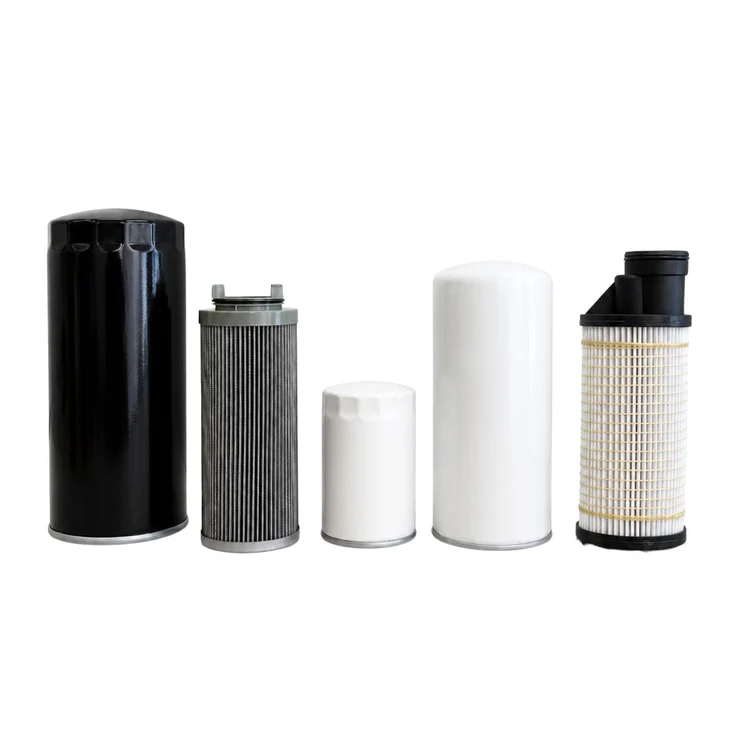
A sealed steel canister that screws onto the filter head. Media, valves and housing are one part, changed together. Identified by the thread (1"-12 UNF, 3/4"-16 UNF and 1 1/2"-16 UN are the common ones), the gasket diameter, the body diameter and the height.
Cartridge elementthe housing stays
An open element with end caps and O-rings that drops into a housing on the machine. Common on larger compressors; less steel in the bin at every service. Identified by outer diameter, inner diameter and height.
With or without bypasscheck before ordering
The bypass valve sits either in the filter or in the head. A filter with the wrong setting opens too early, sending dirty oil round the media, or too late, starving the bearings. The product page states the setting where the filter carries one.
Cellulose
Resin-impregnated paper pleats: the standard medium, rated by the particle size it holds at 99% efficiency.
Microglass
Finer glass fibres with a higher beta ratio: more small particles caught per pass and more capacity before the bypass opens, for longer intervals and synthetic oils.
Caps, spring and seals
Reinforced end caps, a spring that keeps the pleats seated under pulsation and seals rated for continuous duty at the oil temperature. The parts you do not see decide whether the media stays where it belongs.
How to identify yours.
Three ways, in order of certainty. The platform accepts any of them.
- 01
Read the number. The OEM or previous supplier's part number is printed on the canister or the end cap, and listed in the compressor's service manual. Type it into Compressor Parts Finder and it returns the OCP equivalent.
- 02
Know the machine. Brand and model (and serial range, where it matters) are enough: the platform lists the oil filter, air filter, separator and oil the model takes.
- 03
Measure it. Body diameter (D1), outer diameter of the gasket (D2), the thread (G1) and overall height (H1), in millimetres. For a cartridge, outer and inner diameter and height. Compare them, and the bypass setting, with the product page.
When to replace it.
A loaded oil filter does not stop the compressor; it opens its bypass and lets dirty oil through. Nothing on the panel tells you that.
Differential pressure
The bypass valves on the filters in the range open between 1.4 and 3 bar, depending on the model. Where the machine has a filter gauge or a controller alarm, that is the signal; where it does not, the interval is.
Running hours
Standard filters are rated 2,000 to 4,000 hours; long-life versions in the range 8,000. Always with the oil change, whichever comes first, and sooner in hot or dirty duty.
What you see
Oil temperature climbing, pressure or flow dropping, noise from the element, separators that need replacing early: the filter is in bypass or starving the circuit.
Depressurise and drain, clean the filter head, oil the new gasket, hand-tighten and add three quarters of a turn, then check for leaks at start-up. Change the oil, the oil filter and the separator together: they share one circuit, and a new filter in old oil loads up in days.
From the Knowledge Portal.
Learn how varnish affects your compressor
Varnish is one of the most overlooked threats inside rotary screw compressors. Formed by lubricant oxidation and thermal stress, these hard deposits reduce…
Knowledge PortalOil Filters in Screw Compressors — Function, Warning Signs, and Replacement Best Practices
The oil filter protects the entire lubrication circuit of a rotary screw compressor. Learn how it works, how to detect clogging or bypass activation, and why…
Knowledge PortalThe Importance of Preventive Maintenance in Air Compressors
Preventive maintenance is essential to avoid costly breakdowns in industrial air compressors. This article explains how filters—air, oil, and air-oil…
Cross-references and application data are compiled from technical catalogues and OEM literature for reference. Verify dimensions, mounting and pressure rating against your equipment manual before ordering.