
Where compressed air becomes clean air.
The compressor delivers air that is hot, wet and carries a trace of oil. Line filters take out the particles, the aerosols and the vapour, stage by stage, until the air meets the ISO 8573-1 class your process needs.
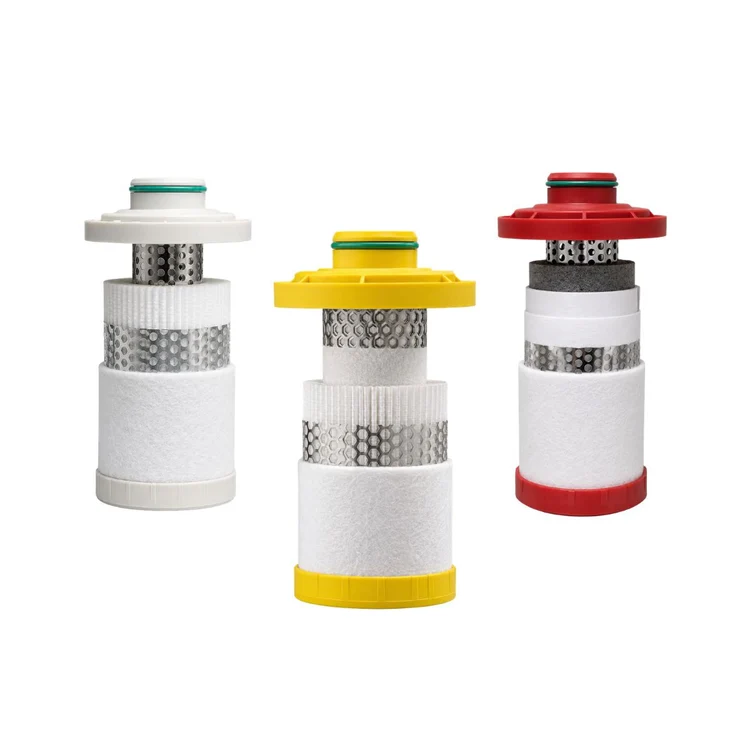
Four stages from the receiver to the process.
No single element does it all. Each stage is sized for one kind of contaminant and protects the one after it.
After the compressor
The air leaves the separator with a few ppm of oil, saturated with water vapour and carrying rust and scale from the pipework. The aftercooler and the receiver drop the bulk water; the rest is the filters' job.
Particulate
A pre-filter stops rust, scale and dust down to the micron range. It takes the solids so the coalescer behind it does not clog on them.
Coalescing
Air flows through a deep bed of borosilicate microfibre. Oil and water aerosols hit the fibres, merge into droplets, migrate to the outer drain sock and fall to the bowl, where the drain removes them. A fine coalescer brings oil aerosol down to the 0.01 mg/m³ that ISO 8573-1 Class 1 asks for.
Vapour and dust
After the dryer, an activated carbon element adsorbs the oil vapour and odour that no coalescer can catch, and a dust filter stops desiccant fines. Carbon always sits behind a coalescer, never alone.
Three ways into the housing, three kinds of media.
The housing brand and size decide the element's mounting and dimensions. The grade decides the media inside it.
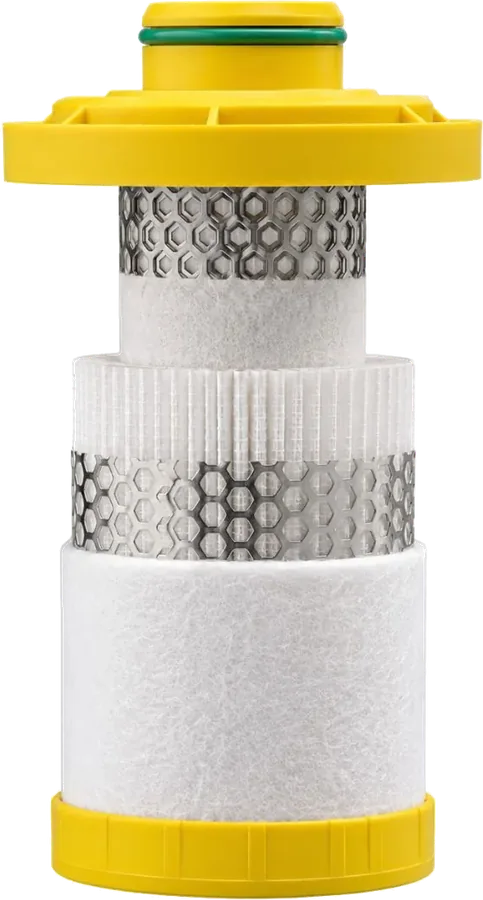
- 01Neck with the O-ring
- 02End cap
- 03Perforated inner support sleeve
- 04Coalescing microfibre layers
- 05Outer support sleeve
- 06Drain sock
Threaded or push-in neckthe most common
The element hangs from the housing head by a neck: threaded, push-in with an O-ring, or bayonet. Identified by neck diameter and type, outer diameter and height.
Tie-rod and handle capclamped
An open-ended element clamped between the head and the bowl by a central tie-rod, or held by a cap with a handle. Identified by outer diameter, inner diameter and height; the gaskets at both ends come with it.
Conical and plate-mountedbrand-specific
Elements with a conical cap, a square plate or a four-bolt flange, each proprietary to one housing family. The housing model is the surest way to identify them.
Borosilicate microfibre
A deep, graded bed of fine glass fibres for coalescing: aerosols are caught in depth and drained, with the grade set by fibre fineness and bed depth.
Pleated particulate
Pleated cellulose or synthetic media for the pre-filter and dust stages: high flow, low pressure drop and large solids capacity.
Activated carbon
Granular or impregnated carbon that adsorbs oil vapour and smell. It has a fixed capacity and no pressure-drop signal when it is spent, so it is changed on time, not on the gauge.
How to identify yours.
Three ways, in order of certainty. The platform accepts any of them.
- 01
Read the number. The element number is printed on the end cap, and the housing carries a label with its model and the element it takes. Type either into Compressor Parts Finder and it returns the OCP equivalent in the same grade.
- 02
Know the housing. Housing brand and model, or the compressor it came with, are enough: the platform lists the elements for each housing size and grade.
- 03
Measure it. Outer diameter (D1), diameter of the neck or end cap (D2) and overall height (H1), in millimetres, plus the grade marked on the old element. Two elements with the same dimensions and a different grade are not interchangeable.
When to replace it.
A coalescing element never recovers: the pressure drop only goes up, and so does the power bill behind it.
Differential pressure
The gauge on the housing is the honest measure. Past the limit in the housing manual, a loaded element costs up to 10% more energy to push the air through, before any air quality problem shows.
Running hours
Most housing manufacturers specify an interval in this range or a yearly change. Oil carry-over from a tired separator, water from a struggling dryer and dirty pipework shorten it.
What you see
Traces at the tools or in the product, a drain that runs constantly, corrosion at the housing threads or a deformed element: the element is saturated or the housing seal has gone.
Depressurise the housing before opening it, check the bowl, the drain and the O-ring on the head, and fit the stages in order: particulate before coalescing, carbon after the dryer, never a carbon element without a coalescer in front of it. Change all stages at the same service.
From the Knowledge Portal.
Line Filters and Coalescing Housings: The Unsung Heroes of Clean Compressed Air
Line filters and coalescing housings are essential for delivering clean, dry, and oil-free compressed air. Learn how they remove contaminants, support ISO…
Knowledge PortalHow to Ensure Air Quality in Industrial Compressed Air Systems
Compressed air quality directly impacts product integrity, equipment reliability, and ISO compliance. Learn how contaminants enter your system, how ISO 8573-1…
Knowledge PortalThe Importance of Preventive Maintenance in Air Compressors
Preventive maintenance is essential to avoid costly breakdowns in industrial air compressors. This article explains how filters—air, oil, and air-oil…
Cross-references and application data are compiled from technical catalogues and OEM literature for reference. Verify dimensions, mounting and pressure rating against your equipment manual before ordering.