
The part that keeps the oil in the compressor.
In an oil-injected screw compressor the oil cools, seals and lubricates the element and leaves with the air. The separator takes it back out before the air reaches your plant, drop by drop, for thousands of hours.
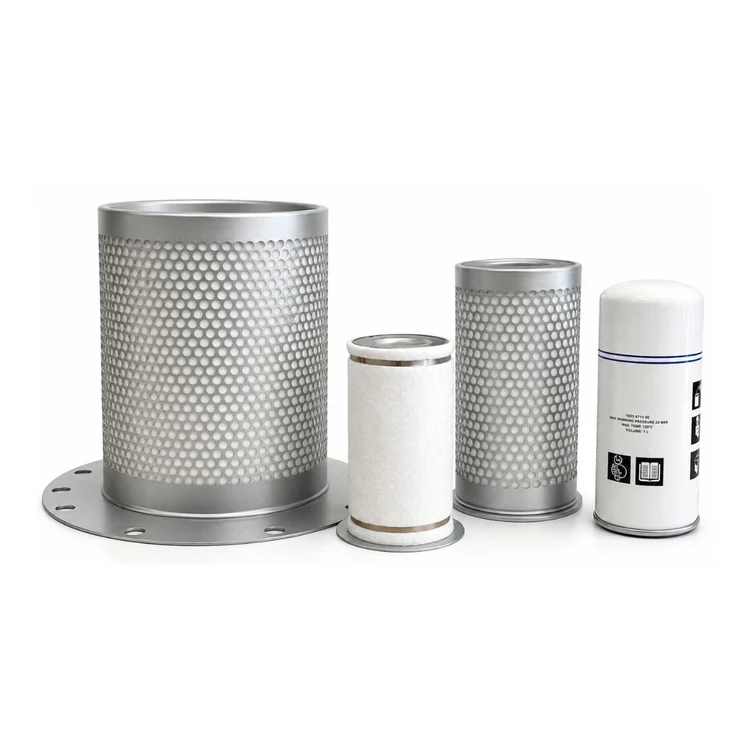
Four steps from oil mist to clean air.
The separator is the second half of a two-stage process. The tank does the heavy lifting; the element does the fine work.
Injection
The compressor injects oil into the rotors to seal the gaps, carry away the heat of compression and lubricate the bearings. Air and oil leave the element together as a hot mist.
The tank
The mixture enters the separator tank tangentially. Speed drops, the flow swirls, and most of the oil falls out by centrifugal force and gravity.
The element
What is left, a fine aerosol, passes through the separator media. Droplets collide with the glass fibres, merge, grow heavy and drain to the bottom of the element.
The scavenge line
The collected oil returns to the compressor through the scavenge line. Clean air leaves with typically less than 3 ppm of residual oil, the basis for ISO 8573-1 air quality downstream.
Three constructions, one job.
Which one your machine uses is decided by the tank. The element is matched by its mounting, its dimensions and the air flow it has to handle.
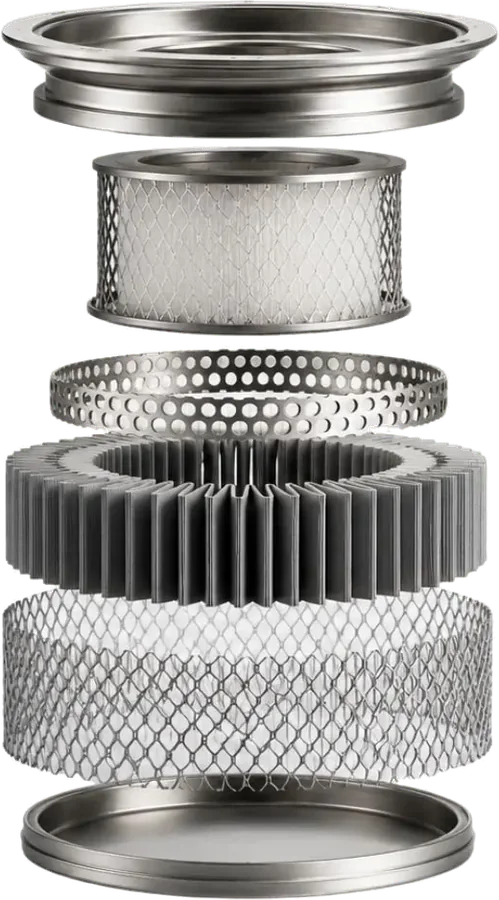
- 01Flange with the gasket seat
- 02Pre-separation layer
- 03Perforated inner support tube
- 04Pleated coalescing media
- 05Outer support screen
- 06End plate
Flanged elementthe most common
Sits inside the separator tank under the lid, clamped between two gaskets. The flange carries the seal and, in most designs, the staple that grounds the element against static charge. Identified by flange diameter, body diameter and height.
Cartridge (drop-in)open-ended
An open element that drops into a housing or a dedicated separator vessel, sealed by O-rings or end gaskets rather than a flange. Found on larger machines and in housings that take two or more elements side by side.
Spin-onsmall compressors
A sealed canister that screws onto a head, like an oil filter. Element and housing are one part, changed together. Identified by thread, gasket diameter and height.
Wrapped media
Layers of glass-fibre media wound around the support tube. Depth filtration with a large oil-holding capacity; the classic construction.
Pleated media
The same fibres pleated for more surface in the same envelope: lower pressure drop at the same flow, or more flow at the same size.
Depth media
Thick, graded layers for high-flow and high-contamination duty, where holding capacity matters more than compactness.
How to identify yours.
Three ways, in order of certainty. The platform accepts any of them.
- 01
Read the number. The OEM or previous supplier's part number is printed on the element's end plate or label, and listed in the compressor's service manual. Type it into Compressor Parts Finder and it returns the OCP equivalent.
- 02
Know the machine. Brand and model (and serial range, where it matters) are enough: the platform lists the separator, filters and oil the model takes.
- 03
Measure it. Outer diameter of the body (D1), diameter of the flange or gasket (D2), inside diameter of the bore (D3) and overall height (H1), in millimetres. For a spin-on, the thread instead of D2. Compare them with the dimensions on each product page.
When to replace it.
The element does not fail suddenly; it loads up. Differential pressure across it is the honest measure.
Differential pressure
Measured between the compressor outlet and the separator tank. Replace at about 0.8 bar, or at the limit the manufacturer specifies. Running on a loaded element can cost up to 10% more power.
Running hours
Most manufacturers specify an interval in this range; dust, humidity, temperature and oil quality shorten it. The service manual is the reference.
What you see
Oil in the downstream filters or at the outlet, more frequent top-ups, foam, or a rising discharge temperature: the element is saturated or the media is damaged.
Change the air filter and oil filter at the same time, check the scavenge line and its non-return valve, and clean the tank sealing faces before the new element goes in. A new separator behind a dirty air filter does not last.
From the Knowledge Portal.
Oil Separator Failure Symptoms and Maintenance Guide for Screw Compressors
The air-oil separator is critical to compressor efficiency and air purity. Learn how it works, how to monitor differential pressure (ΔP), identify early…
Knowledge PortalHow to Identify and Replace the Oil Separator in Your Screw Compressor
Oil separators are critical to the efficiency and reliability of rotary screw compressors. Learn how they work, how to identify failure signs, and how to…
Knowledge PortalThe Importance of Preventive Maintenance in Air Compressors
Preventive maintenance is essential to avoid costly breakdowns in industrial air compressors. This article explains how filters—air, oil, and air-oil…
Cross-references and application data are compiled from technical catalogues and OEM literature for reference. Verify dimensions, mounting and pressure rating against your equipment manual before ordering.