
The first thing the air meets.
Every cubic metre a screw compressor draws in carries dust, soot and fibres. The air filter stops them before the inlet valve, the rotors and the oil circuit, and it decides how hard the compressor has to work to breathe.
Four steps from the room to the rotors.
The air filter is the only barrier between the plant floor and the compression element. Everything that passes it ends up in the oil.
Intake
The compressor draws air through the housing inlet. On larger machines a pre-cleaner spins the coarse dust out first, so the element only sees the fine fraction.
Outside in
Air passes through the pleated media from the outside to the inside. Particles are held on the surface and inside the fibres; the dust cake that builds up actually sharpens the filtration over time.
The seal
The end cap seals the clean side from the dirty side, radially on the outlet tube or axially against the housing. A tired seal lets dust straight past a perfectly good element.
Clean to the element
The air reaches the inlet valve and the rotors clean. What the filter lets through grinds in the bearings, loads the oil filter and shortens the separator, in that order.
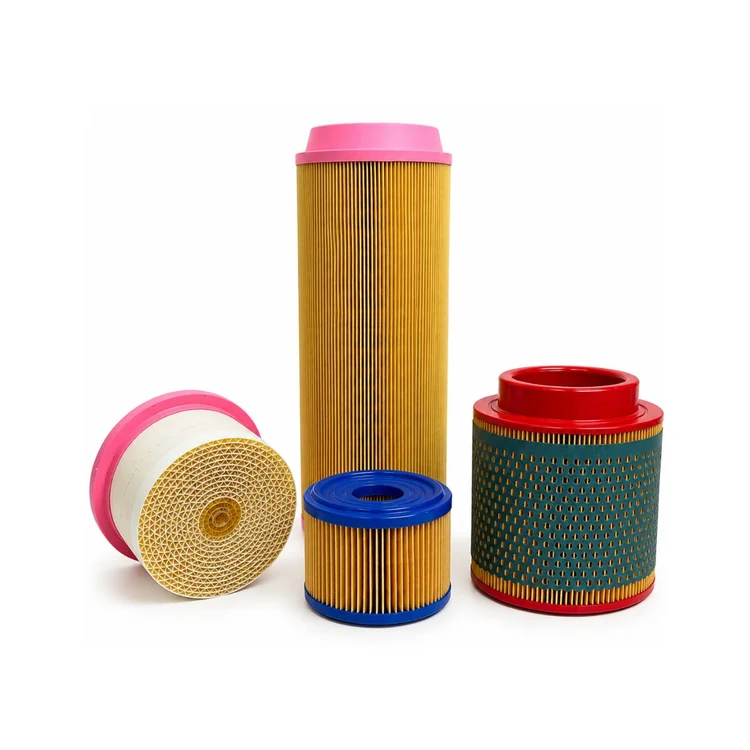
Three constructions, one job.
The housing decides the construction. The element is matched by its seal, its dimensions and the air flow the compressor draws.
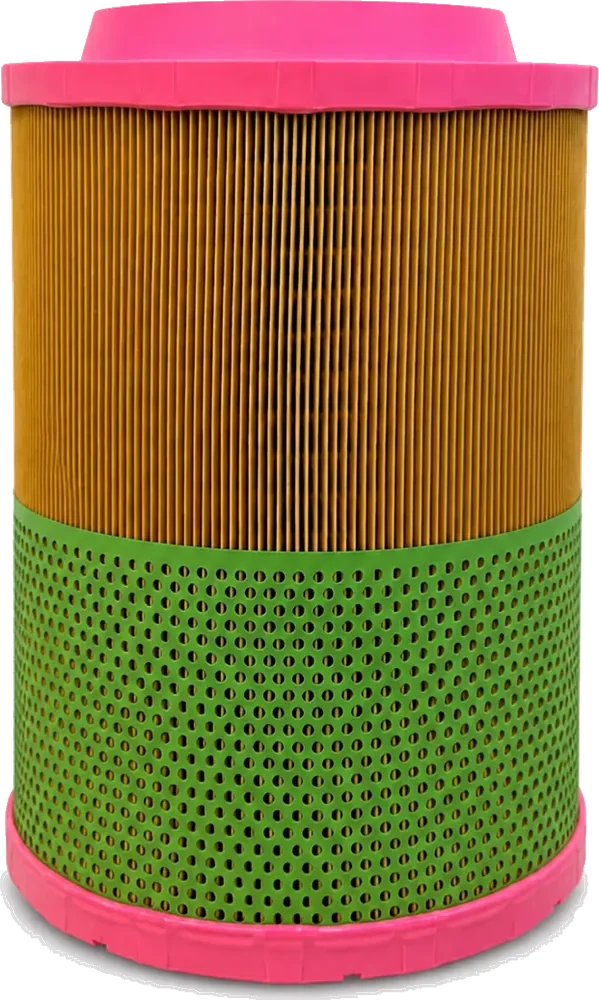
- 01Radial seal on the end cap
- 02Polyurethane end cap
- 03Pleated cellulose media
- 04Inner support tube behind the pleats
- 05Perforated outer screen
- 06Closed bottom cap
Cartridge, radial or axial sealthe most common
A cylindrical element with moulded polyurethane end caps. The radial type seals on the inside of the end cap against the housing outlet tube; the axial type is pressed flat against the housing by the cover. Identified by outer diameter, inner diameter at the seal and height.
Panel and obroundcompact machines
A flat or oval block of pleats in a frame, for housings that sit against a side panel. Identified by length, width and depth rather than diameters.
Two-stage: primary and safety elementdusty sites
A second, finer element sits inside the primary one. It protects the compressor while the primary is changed and catches whatever a damaged primary lets through. Both are listed and both are changed.
Cellulose
Resin-impregnated paper, the standard in general industry: good capacity at a low pressure drop, tested to ISO 5011 for efficiency and dust holding.
Synthetic and blended
A synthetic or nanofibre layer on the cellulose holds the fine dust on the surface instead of in depth: higher efficiency and a longer interval in the same envelope.
Pleat geometry
More and deeper pleats mean more surface in the same housing: lower restriction at the same flow. Pleat count and stability under pulsation are what separate a good element from a cheap one.
How to identify yours.
Three ways, in order of certainty. The platform accepts any of them.
- 01
Read the number. The OEM or previous supplier's part number is printed on the end cap or on a label on the housing, and listed in the compressor's service manual. Type it into Compressor Parts Finder and it returns the OCP equivalent.
- 02
Know the machine. Brand and model (and serial range, where it matters) are enough: the platform lists the air filter, oil filter, separator and oil the model takes.
- 03
Measure it. Outer diameter of the body (D1), inner diameter at the seal (D2) and overall height (H1), in millimetres. For a panel, length, width and depth. A two-stage housing has two sets of dimensions, one per element.
When to replace it.
The element does not fail suddenly; it loads up, and the compressor pays for it in power before anything breaks.
Restriction
Every 100 mbar of extra restriction at the intake costs about one percent in energy; a fully loaded element five to ten. Change it at the limit in the manual or when the restriction indicator trips, never by looking at it.
Running hours
The usual interval in a normal industrial environment. Dust, humidity and heat shorten it; a machine next to a loading bay or a grinding line can need half of that.
What you see
Dust inside the outlet tube, an oil filter and separator that load faster than they used to, longer load times or a rising discharge temperature: the element is loaded or the seal has failed.
Keep the housing open as briefly as possible, wipe the outlet tube before the new element goes in, check the seal face and the clamps, and reset the restriction indicator. Never blow out or wash a paper element: it tears the media and lets the fine dust through.
From the Knowledge Portal.
Air Filters in Screw Compressors — Efficiency, Pressure Drop, and Best Replacement Practices
The air filter is the first line of defense in a rotary screw compressor. Discover how proper filtration protects rotors and bearings, reduces energy…
Knowledge PortalHow to Improve the Energy Efficiency of Your Screw Compressor
Energy accounts for up to 80% of a screw compressor’s total cost of ownership. Discover practical strategies to reduce power consumption, eliminate waste,…
Knowledge PortalThe Importance of Preventive Maintenance in Air Compressors
Preventive maintenance is essential to avoid costly breakdowns in industrial air compressors. This article explains how filters—air, oil, and air-oil…
Cross-references and application data are compiled from technical catalogues and OEM literature for reference. Verify dimensions, mounting and pressure rating against your equipment manual before ordering.